Verification & trust
Fleet-Scale Verification: One Operator, Many Reactors
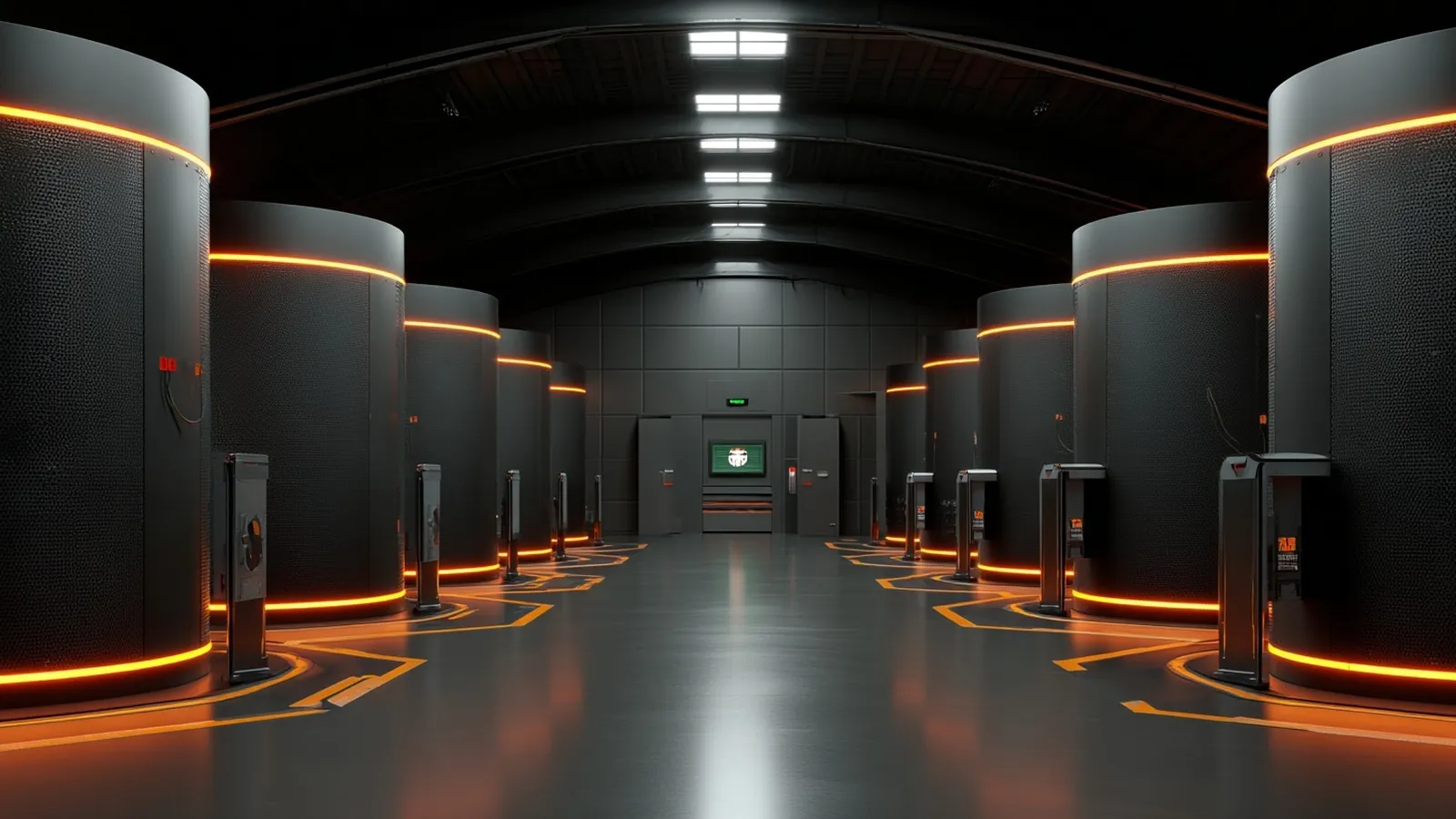
A single reactor can be watched closely. A fleet of them cannot be watched the same way. Once one operating organization oversees many <a class="link" href="/resources/what-is-a-nuclear-microreactor">microreactors</a> across many sites, attention becomes the scarce resource, and the question shifts from whether someone is looking at each unit to whether each unit can prove its own condition without someone looking. That is the verification problem at fleet scale.
This matters now because the regulatory direction is moving toward it. The NRC's proposed Part 57 rule, published in the Federal Register on May 1, 2026, contemplates remote operation and reduced on-site staffing for microreactors [1]. The rule is proposed rather than final and the comment period closed in June 2026, so nothing here describes settled law. But the direction is clear enough that the operating model deserves scrutiny before it arrives.
This article is about the structural problem rather than any particular product. RankShield Energy is a pre-applicant with the NRC and operates no fleet [3]. What follows is the reasoning we apply to our own design work, offered because the industry will have to answer it collectively.
Key takeaways
- At fleet scale, human attention per reactor falls, so more of the safety story has to be carried by evidence the reactor produces.
- Verification does not simply multiply. Twenty units generate more than twenty times the reconciliation work if each is checked ad hoc.
- Fleet verification has to be per-unit, comparable across units, and checkable by someone outside the operator.
- Proposed Part 57 contemplates remote operation and reduced on-site staffing, but it is not final and grants no approval today.
- The honest status: the operating model is being demonstrated at national-lab scale; fleet-wide independent verification is still ahead of the industry.
What changes when one organization oversees many reactors
With a single reactor, oversight can lean on proximity. People are present, they see the plant, and their judgment fills gaps that instrumentation misses. Scale that to twenty units across several sites and proximity stops being available in the same way. The staff-to-reactor ratio falls by design, because that economics is part of why modular fleets are attractive in the first place.
What replaces proximity is reporting. Each unit describes its own condition, and the operating organization forms a picture from those descriptions. This is a reasonable model, and it is how many distributed industrial systems already work. But it changes what a claim of safe operation rests on: not what an experienced person observed, but whether the reporting itself can be trusted.
That is the shift worth naming plainly. At fleet scale, trust in operations becomes trust in evidence.
Why verification does not simply multiply
The naive assumption is that verifying twenty reactors is twenty times verifying one. In practice it is worse than linear if each unit is handled ad hoc, because the work is not only checking each reactor. It is reconciling them: determining whether unit seven behaving slightly differently from the other nineteen is a sensor problem, a maintenance issue, a genuine divergence, or nothing at all.
That reconciliation is where fleet oversight gets expensive and where it quietly degrades. Small anomalies across many units are exactly the pattern human attention handles worst, particularly when most of them turn out to be benign. The failure mode is not dramatic; it is a slow normalization in which differences stop being investigated because they usually amount to nothing.
Designing against that means the fleet has to produce evidence in a form that makes comparison cheap and divergence obvious, rather than leaving reconciliation as an exercise performed by whoever is on shift.
What fleet-scale verification actually has to produce
Three properties matter, and all three have to hold at once. The first is that verification is per-unit. A fleet-level summary that averages away individual behavior is a dashboard, not verification, and averages are precisely where a single divergent unit disappears.
The second is that records are comparable across units. If each reactor reports in its own idiosyncratic way, reconciliation stays manual and the cost of oversight grows with fleet size. Comparability is what lets an anomaly stand out against nineteen siblings instead of requiring someone to notice it.
The third is the one this site keeps returning to: the confirmation has to be checkable by someone other than the operator. At single-reactor scale a regulator can compensate for weak evidence with inspection. Across a distributed fleet that compensation does not scale either, which makes independent, machine-checkable evidence more load-bearing rather than less. The attestation architecture that formalizes this separation, with a verifier distinct from the party being checked, is well established outside nuclear [2].
Where this stands today, honestly
The operating model is further along than the verification model. In July 2026, Idaho National Laboratory and university partners demonstrated remote, real-time autonomous power control of a research reactor, with safety systems retaining control throughout [4]. That is a national-lab demonstration of remote and autonomous operation, not a demonstration of fleet-wide independent verification, and not a result belonging to any vendor including us.
On the regulatory side, proposed Part 57 contemplates remote operation and reduced on-site staffing [1], but it is a proposal. No developer is licensed under it, and safety-significant actions keep a human in the loop. Nobody today is running a large fleet of microreactors under independent continuous verification, because nobody is running a large fleet of microreactors at all.
So the honest framing is that this is a problem to solve before it is urgent rather than one already solved. The reason to write about it now is that verification designed after a fleet is deployed tends to be verification bolted on, and bolted-on evidence is exactly the kind an outside party has the least reason to trust.
Frequently asked questions
Does NRC Part 57 allow one operator to run many reactors?
Proposed Part 57 contemplates remote operation and reduced on-site staffing for microreactors, which points toward fleet-style oversight <sup><a href="#src-1">[1]</a></sup>. Two caveats matter. It is a proposed rule, published May 1, 2026, with the comment period closed in June 2026, so it is not in effect and no developer is licensed under it. And contemplating an operating model is not the same as approving any particular staffing arrangement, which would be evaluated for a specific design under review. Treat it as regulatory direction rather than present permission.
Why is verifying a fleet harder than verifying one reactor?
Because the difficulty is not only per-unit checking, it is reconciliation. With many units, most differences between them turn out to be benign, which is exactly the condition under which anomalies stop being investigated. Human attention degrades against high-volume, mostly-uninteresting variation. A fleet therefore needs evidence that is per-unit, directly comparable across units, and produced in a form where divergence is obvious rather than something a person has to notice while managing nineteen other reactors.
Is anyone operating a microreactor fleet under independent verification today?
No. Nobody is operating a commercial microreactor fleet at all yet, so fleet-scale independent verification does not exist in practice. What does exist is a national-lab demonstration of remote, autonomous power control of a research reactor <sup><a href="#src-4">[4]</a></sup>, and a proposed regulatory framework that contemplates the operating model <sup><a href="#src-1">[1]</a></sup>. RankShield Energy is a pre-applicant and operates no fleet <sup><a href="#src-3">[3]</a></sup>. Anyone describing fleet verification as a solved capability is describing an intention.
What should a buyer ask a vendor about fleet operations?
Ask how evidence from each unit is produced, whether it is comparable across units, and who confirms it besides the operator. Then ask what happens when one unit diverges from the others: who is alerted, what record is created, and could an outside party reconstruct that sequence afterward without the vendor's help. Answers that describe a monitoring dashboard are describing operations. Answers that describe records an outside party can independently check are describing verification, and only the second scales with fleet size.
Sources
- U.S. Nuclear Regulatory Commission. Licensing Requirements for Microreactors and Other Reactors With Comparable Risk Profiles (proposed 10 CFR Part 57). Federal Register, May 1, 2026 (91 FR 23628)
- Internet Engineering Task Force (RFC Editor). RFC 9334: Remote ATtestation procedureS (RATS) Architecture. January 2023
- U.S. Nuclear Regulatory Commission. Pre-Application Activities for Advanced Reactors. Accessed July 2026
- Idaho National Laboratory. Researchers achieve remote, autonomous power control of a research reactor in real time. July 2026
This guide reflects the state of NRC microreactor rulemaking as of July 2026. Proposed rules such as 10 CFR Part 57 are not final and may change. Check back if the rule is finalized or the NRC issues new guidance.
About this article. RankShield Energy is a pre-applicant engaged in early regulatory interaction with the U.S. Nuclear Regulatory Commission (NRC). Nothing here should be read as a representation that any RankShield Energy design, product, or facility is NRC-approved, licensed, or certified, or that any safety, performance, or operational characteristic has been demonstrated or accepted by the NRC. Descriptions of reactor and system behavior reflect design intent and are subject to analysis, testing, and regulatory review. This article is for general educational purposes and is not engineering, legal, regulatory, or investment advice.
A note on how we write about our own reactor
HELIX is in pre-application development. Where this article touches our design, every figure is a design target and every physics result is unqualified screening, labeled as such. We cite authoritative sources (NRC, DOE, IAEA, national laboratories) and never invent statistics.
RankShield Energy · HELIX · pre-application