Site output
4–100 MWe
RankShield Energy · HELIX · Pre-application development
Firm power now takes years to buy: interconnection queues run past half a decade and capacity prices have hit record caps. HELIX is the alternative, a sealed microreactor with no pumps and no water, walk-away safe by physics, set on a prepared pad in days, and engineered so an operator, insurer, or regulator can prove what it is doing instead of taking it on faith.
Power that arrives instead of waiting in an interconnection queue. Identical factory-sealed HELIX modules rated 4.40 MWe at the cycle number up from one for a hotel or campus to twenty-plus for a hyperscale site. Each module is set-and-connect on a prepared pad and cooled entirely by dry air, no cooling tower, no water draw. An N+1 reserve module carries an outage. Outbound the module is oversize and permittable at 2.70 m; whether it travels on ordinary roads or needs superload permitting turns on an envelope question we have not closed, and we say so.
RankShield is a verification company first; HELIX is the reactor built on that foundation. A graphite-moderated TRISO core at the 19.75% HALEU ceiling, sealed sodium heat pipes with no pumps and no water, and fully-passive walk-away safety, built to be verified, not just trusted.
Factory-built, trucked to site as an oversize load, and core-exchanged on a roughly 6 to 7 year cadence. A non-safety attestation layer lets an operator, an insurer, or a regulator independently check the module's integrity, from the factory floor to every operating hour.
Cutaway is illustrative · 2.70 m pressure-boundary diameter · core 3.00 m, overall height not yet fixed

Reactivity is held by strong negative-temperature feedback; sixteen control drums and a diverse shutdown rod insert fail-safe on loss of power. Decay heat is removed by natural-draft air cooling and radiation alone, and because there is no pump anywhere in the reactor, there is no loss-of-flow accident class at all, no valve, no operator action. An independent digital-safety platform provides deterministic protection; the attestation layer observes from outside this boundary and can never command it.
UCO-TRISO fuel at 19.75% HALEU in a graphite core block, ringed by sixteen B4C control drums with a diverse central shutdown rod, its heat carried out by sealed sodium heat pipes. Our continuous-energy Monte Carlo screening (unqualified, pre-QAPD) shows a strongly negative temperature coefficient, ample shutdown margin, and a reactivity-limited life of 6.67 full-power years at the current design point, bounded between 6.67 and 6.91 pending resolution of the energy-per-fission normalisation, inputs to design, not credited safety analysis.
Identical sealed modules on a prepared pad, a molten-salt thermal buffer, dry sCO2 conversion skids, dry coolers, and the grid interconnection skid, the whole plant with no cooling water, no on-site nuclear work, no deep vault excavation, and sealed-core exchange on a roughly 6 to 7 year cadence.
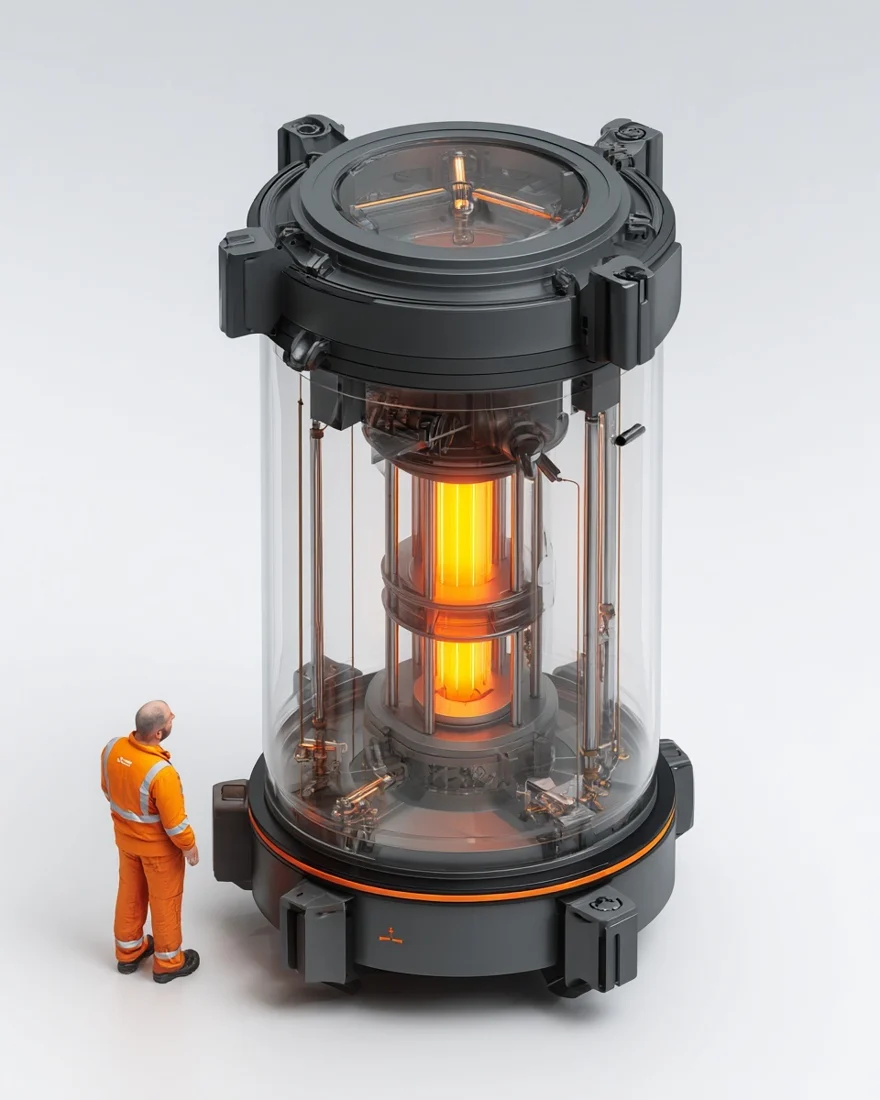 1 5 4 3 2 6 OPERATOR
The whole reactor arrives sealed and never opens on site, though it is rechargeable rather than disposable: the core is exchanged at the factory, not in the field. Cut it away and there are only six things that matter, and no pump, no valve, and no drop of water among them.
Tap a number on the cutaway, or a card below, to highlight the part.
Holds a diverse shutdown rod above the core. On any loss of power it inserts by gravity: fail-safe, no operator, no command.
Sealed pipes wick heat straight out of the core. No pumps, no valves, no water, so there is no loss-of-flow accident class to license against.
UCO-TRISO fuel at the 19.75% HALEU ceiling in a graphite block. Strong negative feedback: as it heats, it powers itself down.
A sealed pressure vessel closed at the factory and never opened in the field. The module trucks in, sets on a pad, and connects.
Heat crosses to a dry supercritical-CO₂ loop on bolt-on skids, ~40% net, air-cooled, zero cooling water.
Instruments every operating hour and keeps a tamper-proof record: the same data that runs the plant efficiently and that a lender or insurer can check.
Cutaway is illustrative · 2.70 m pressure-boundary diameter · attestation features are design targets
Why HELIX wins the deal
HELIX will not beat a gas turbine on sticker price per megawatt-hour, and several vendors will sell a sealed microreactor this decade. We are not trying to win that number. We are trying to win the one on your P&L: the delivered, risk-adjusted cost of firm, clean power over twenty years. Four things move that number, and the reactor core is not one of them.
Dry sCO₂ conversion at ~40% net, plus continuous self-monitoring that flags wear before it becomes an outage. On a plant this size every point of capacity factor is revenue you would otherwise lose, and that monitoring is the same data the verification layer signs.
A reactor that continuously proves its own condition is one a lender and an insurer can underwrite without guessing. Where capital cost dwarfs fuel cost, shaving the rate moves delivered price more than any fuel saving. That is what "verifiable" buys: a lower rate, not a slogan.
No cooling water, no pumps, minimal on-site staff. Passive walk-away safety and hands-off operation take out fixed costs a conventional plant pays every single year of its life.
Factory-built, trucked in, set on a prepared pad, targeting the NRC's proposed fleet-approval microreactor path. For a buyer who is power-starved today, months instead of years is the whole bottom line.
Security is not a feature bolted on top; it is downside protection. One undetected tamper or a quiet degradation is the single event that strands a twenty-year asset. The same monitoring that runs the plant efficiently is what keeps that from happening, every hour, without anyone having to watch.
Cheapest electron? No. Lowest cost to own firm, clean power you can bank on? That is the race we are running.
Pre-application program · delivered-cost levers are design targets, not yet demonstrated.
Design basis · targets held to an honest ceiling
| Site output | 4.40 MWe at the cycle per sealed module; delivered at the meter is lower and site-specific. Sites number up from one module to 20+ (design target) |
| Heat transport | 421 sealed sodium heat pipes through the core monolith; no pumps of any kind (EM-pumped pool evaluated, not selected) |
| Fuel & core | UCO-TRISO, 19.75 wt% HALEU, graphite-moderated, inside the NRC-accepted EPRI-AR-1(NP)-A particle envelope; 1.80 m core |
| Reflector / control | BeO reflector, 0.40 m radial; 16 B4C control drums + 1 diverse shutdown rod |
| Cooling | Fully dry, forced-draft dry coolers; zero cooling water |
| Power conversion | Dry sCO₂ Brayton, 40% net, air-cooled, on bolt-on skids outside the sealed module |
| Core life | 6.67 full-power yr at the current design point, bounded 6.67–6.91 pending the energy-per-fission normalisation (screening; unqualified) |
| Transport | 2.70 m pressure-boundary OD, oversize and permittable outbound. Road-legal is 2.60 m and costs core life; ordinary-road versus superload permitting is an open question |
| Safety concept | Passive shutdown + natural-circulation decay-heat removal; walk-away |
The verification layer · non-safety, observe-only
This is the part we did not have to invent for the reactor: RankShield already operates a production verification network protecting live infrastructure, and HELIX inherits it. Each site signs its telemetry with post-quantum cryptography and normalizes performance against its own environment. The RankShield Network compares every reactor to what its conditions predict, so drift, whether wear or tampering, stands out against an independent-witness fleet. The layer sits outside the safety boundary behind a hardware one-way path: it can prove integrity, and by construction can never command a safety function. Provable power is easier to staff, insure, certify, and buy: the same witnessed record that shows a regulator the module is intact meters every megawatt-hour for the customer and flags efficiency drift before it costs anything.
Fleet cross-verification · teal = attested · coral = flagged for triage
Regulatory pathway
The NRC's proposed microreactor-specific framework, providing fleet approvals of identical reactors and aimed at simple machines with simple safety systems, which the pumpless walk-away design is built to fit. Proposed, not final; we claim no approval and no application is underway.
The risk-informed, technology-inclusive framework remains the backup pathway, and the scoping work done against it transfers.
Phased plan scoped to a verified compliance register: licensing-basis-event selection, SSC safety classification, mechanistic source term, and Division 5 materials qualification.
A test article under DOE authorization, with quality data collected under NQA-1 from day one, feeding the eventual NRC application, consistent with the NRC's proposed DOE-design-credit pathway.
Stand up the quality-assurance program and preliminary safety analysis before any credited analysis. All physics shown to date is unqualified screening and is not carried forward as credited.
The engineering · thirteen subsystems
UCO TRISO at the 19.75% HALEU ceiling in a graphite monolith, the only advanced fuel form purchasable from multiple US fabricators today.
Sealed sodium heat pipes through the core monolith delivering at 850 °C, no pumps of any kind, which is what lets the same unit serve process heat as well as electricity without redesign. An EM-pumped pool was evaluated and not selected; the decision closed on physics and install engineering, not preference.
Strong negative temperature feedback measured in screening physics; 16 B4C control drums plus one diverse shutdown rod, shutdown worth far exceeds any credible excess.
Beryllium-oxide radial reflector, 0.40 m thick, the configuration our screening physics is run on. Thinning it from 0.50 m is what brought the module to 2.70 m; the reflector is the dominant lever on both envelope and core life, and the trade is documented rather than assumed. Layered borated shielding.
A 50 mm vessel wall around the graphite monolith. Material selection against ASME Section III Division 5 is open and we say so: our maximum operating temperature sits near the boundary where austenitic grades give way to a nickel-base alloy, and that code case is not closed. Not 300,000 hours, comfortably beyond the module's planned service life across factory recharge cycles.
Decay heat leaves by natural-draft air cooling and radiation alone. Nothing powered, nothing moving, no operator action, an availability event, never a safety event.
Dry supercritical-CO2 Brayton conversion at 40% net, air-cooled, on bolt-on skids outside the sealed module that can be serviced or swapped without ever opening it.
A molten-salt buffer lets modules run flat at their sweet spot while stored heat follows demand swings and bridges transients, the reactor never chases load.
Forced-draft dry coolers, variable-speed fans. No water, no cooling tower, no draw against the community that hosts it.
Number-up identical 4.40 MWe modules, one for a campus, twenty-plus for a hyperscale site, with N+1 reserve. Sealed in the field and never opened on site, but not disposable: at end of core life the module is exchanged and its core returns to the factory to be defueled and recharged. The site runs indefinitely on rolling exchange. The honest gap is the return leg, where the irradiated core ships in a Type B cask that is not yet licensed.
Five reference integration archetypes spanning every US facility class, with a pre-engineered adaptive skid and the IEEE 1547 protocol envelope built in.
FPGA deterministic safety on an NRC-approved platform lineage, plus an attested digital twin behind a one-way data diode.
ML-DSA-87 telemetry and SLH-DSA hash-based firmware signing anchored to a witnessed transparency log, from factory floor through transport to every operating hour.
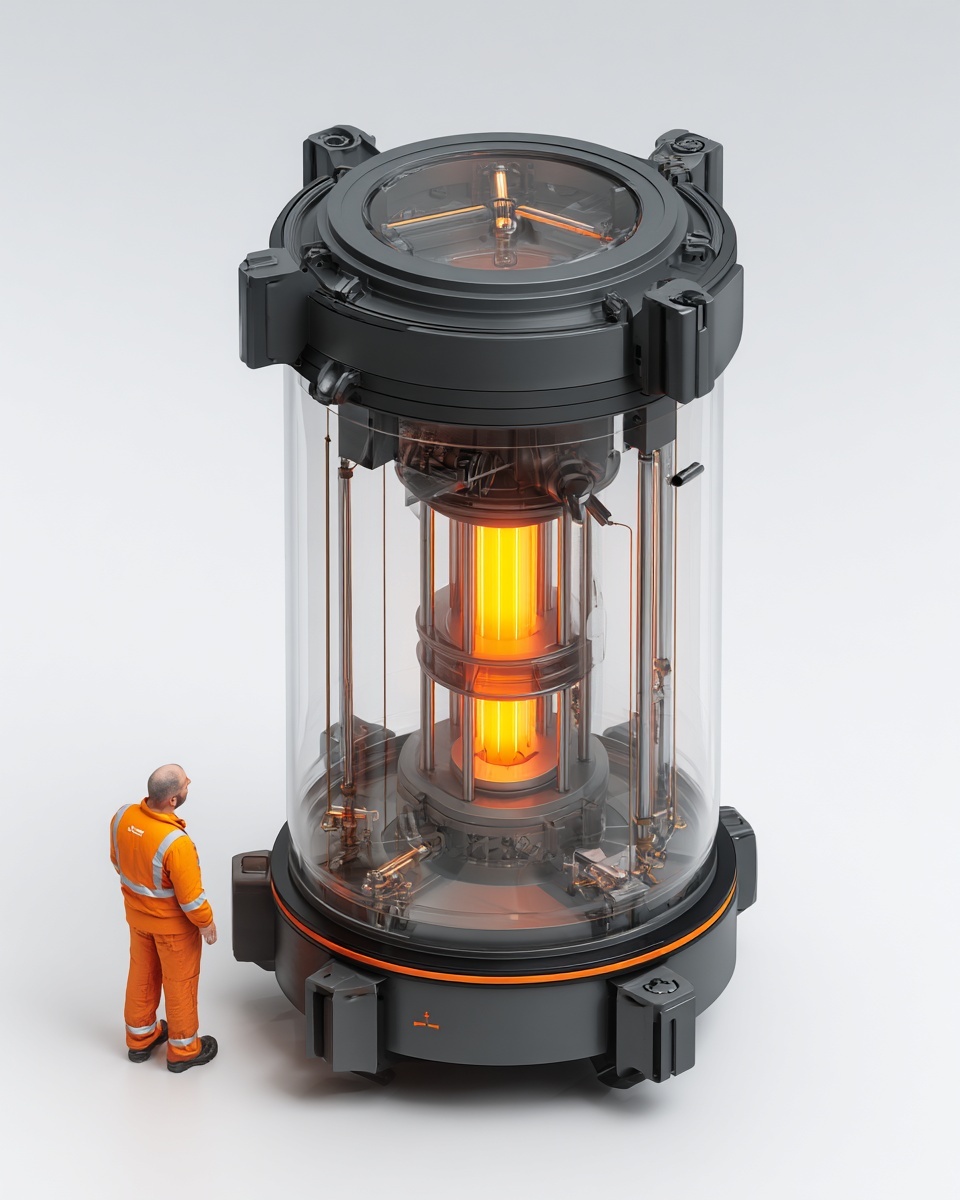
The machine · photoreal cutaway
Cut the module open and there is no pump, no valve, and no drop of water. Sodium heat pipes wick heat straight off a graphite-moderated TRISO core to a dry power loop, the shutdown rod sits above the core and drops by gravity on any loss of power, and the vessel is closed at the factory and never opened in the field. The operator is there for scale.
Cutaway is illustrative · 2.70 m is the pressure-boundary diameter; the shipped envelope adds a casing stack we have not yet fixed.
Honest status · what is done, what is owed
Reactor and integration design consolidated; hundreds of sourced claims adversarially verified; competitive and materials landscape assessed.
Continuous-energy Monte Carlo screening of criticality, lifetime, reactivity feedback, shutdown worth, and post-trip xenon. Screening inputs to design; pre-QAPD; not credited.
Nominal, harsh-environment, chaotic-failure, production, grid/EMC, and long-run internal scenarios; structural/thermal FEA stand-up owed for cascade and stress cases.
Qualified-lane confirmation with independent codes and, ultimately, test data. No claim of validated performance is made.
An NRC application, under Part 57 once the rule is final or under Part 53 as the backup, and confirmed offtake demand are prerequisites to any hardware commitment.
Ask the founder
The questions a regulator, a partner, or an engineer asks about HELIX, answered by the founder. No forms, no sales pitch.